





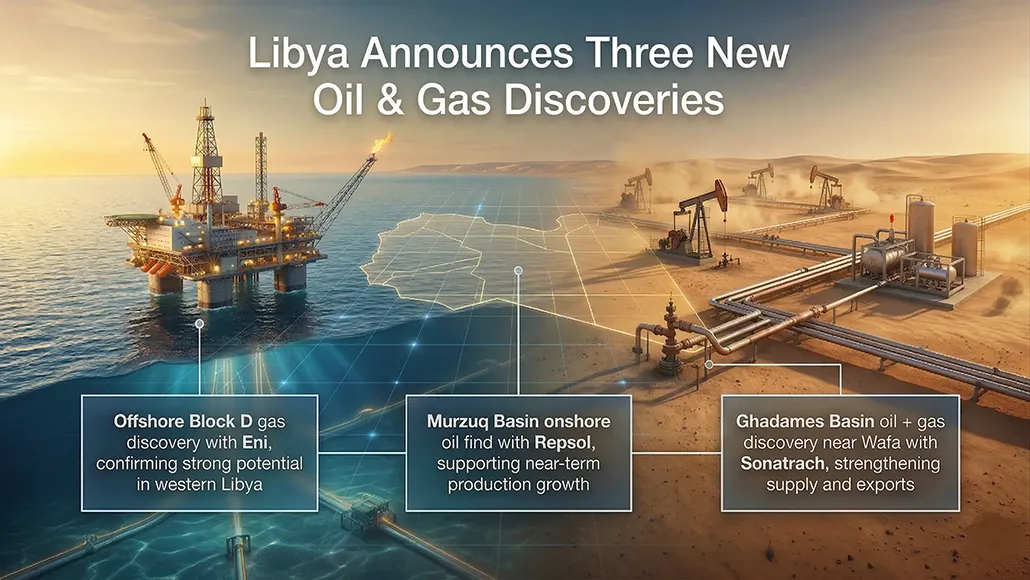
Libya’s national oil company National Oil Corporation (NOC) has reported a fresh wave of upstream success, unveiling three separate hydrocarbon finds in collaboration with Eni, Repsol, and Sonatrach. These developments point to a renewed momentum in exploration across key producing zones, underscoring a broader revival in activity. The latest results highlight a series of new oil and gas discoveries, reinforcing confidence in Libya’s resource base and the continued viability of acreage awarded more than a decade ago.
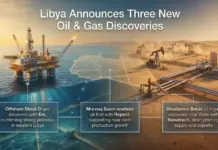
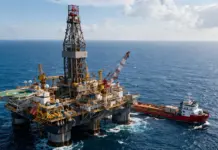
The most prominent of these new oil and gas discoveries was recorded offshore western Libya, where NOC and Eni North Africa drilled the J1-4/16 exploration well in Block D. Located approximately 95 kilometers from shore, the well reached a total depth of 10,458 feet and confirmed a gas find in the Metlawi reservoir. Testing yielded 14 million cubic feet per day (MMcf/d) in one run and 24 MMcf/d in a second test under a wider choke. This milestone also completes the ninth and final contractual exploration obligation under Contract 4/16, originally signed in June 2008.
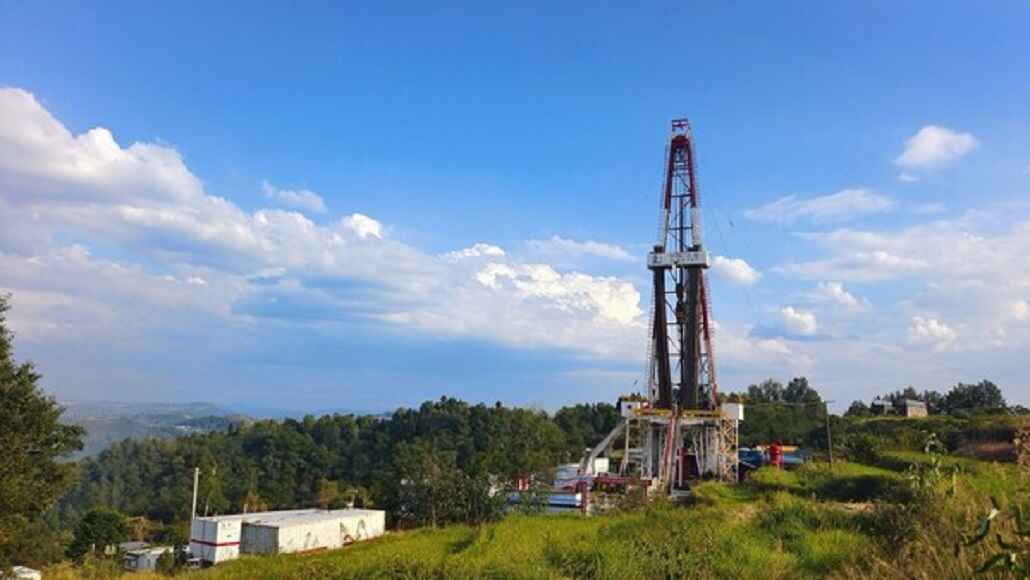
Onshore developments added further weight to Libya’s exploration narrative. In the Murzuq Basin, around 800 kilometers south of Tripoli, NOC and Repsol Libya Branch confirmed an oil discovery in Contract Area 131/130. The J1-4/130 exploratory well, drilled to 4,325 feet, is currently producing an average of 763 barrels per day from the Mummiyat Formation. This well represents the fifth completed under the eight-well commitment outlined in the partners’ 2008 Exploration and Production Sharing Agreement.
At the same time, in the Ghadames Basin, NOC and Sonatrach’s Libyan subsidiary SIPEX reported a combined oil and gas find near the Wafa field. The A1-69/02 exploration well, drilled to 8,440 feet, is producing 13 million cubic feet of gas per day along with 327 barrels per day of condensate from the Awynat Wanin and Awyn Kaza formations. This marks the sixth well drilled out of eight planned under the EPSA signed in May 2008.
Taken together, these new oil and gas discoveries demonstrate sustained success across multiple basins and operators, with both offshore and onshore assets delivering commercially viable volumes. Offshore gas gains added importance as Libya seeks to bolster domestic supply while maintaining its role as a Mediterranean energy supplier. Meanwhile, the Murzuq and Ghadames basin results reaffirm the enduring potential of established onshore regions, where even smaller-scale wells can contribute to near-term production growth. Collectively, these new oil and gas discoveries signal that long-standing contractual acreage continues to yield tangible results despite years of disruption, offering a positive outlook for future upstream investment.
