
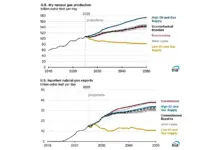
















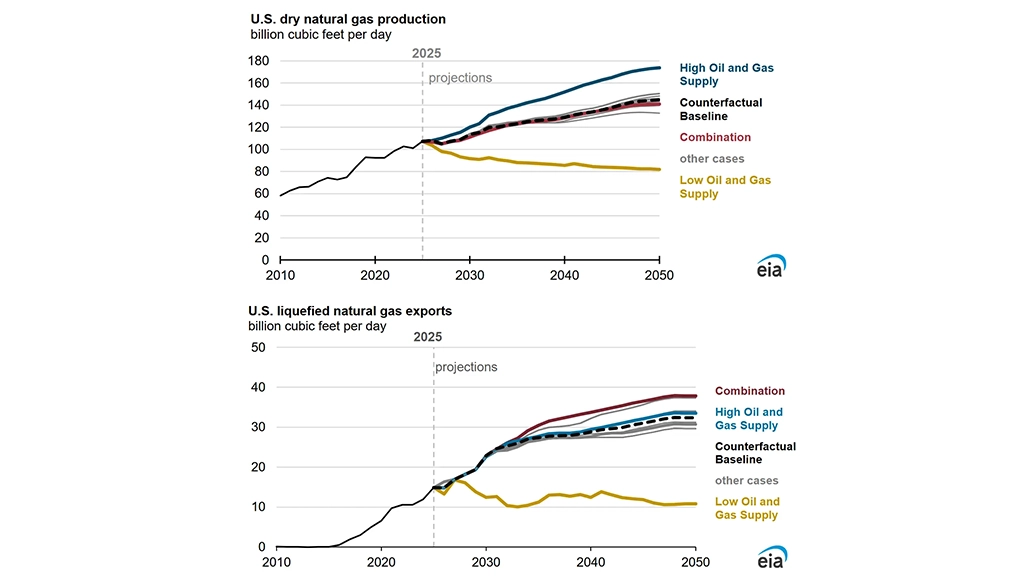
The Energy Information Administration (EIA), in its Annual Energy Outlook 2026 (AEO2026), has outlined a long-term trajectory of sustained natural gas production growth in the United States, with output expected to rise steadily through 2050. U.S. dry natural gas production, which made up 38% of total U.S. energy production in 2025, is projected to expand significantly in response to both domestic consumption and rising global demand. The report evaluates multiple scenarios based on laws and regulations in place as of December 2025, alongside alternative policy assumptions affecting electricity and transportation sectors. It also considers a case examining the effects of higher power demand, particularly from data centers. Across most modeled cases, U.S. dry natural gas production growth is estimated to reach between 20% and 40% by 2050 compared to 2025 levels, with the Low Oil and Gas Supply and High Oil and Gas Supply cases diverging due to differing resource assumptions.
A major driver behind this natural gas production growth is the expansion of U.S. liquefied natural gas (LNG) exports, which are expected to absorb a large share of incremental supply. Export volumes are projected to climb from 15 billion cubic feet per day (Bcf/d) in 2025 to over 30 Bcf/d by 2050 in most scenarios. These projections are largely centered around the Counterfactual Baseline case, while the Combination case records the highest export levels due to the absence of certain transportation and electricity market policies. Without these policies, liquids consumption increases, leading to higher Brent crude oil prices. Because LNG pricing is often indexed to crude oil, U.S. LNG becomes more competitive in international markets. At the same time, lower electricity demand from electric vehicles (EVs) reduces domestic gas consumption for power generation, freeing up additional volumes for export and reinforcing natural gas production growth.
Domestic consumption patterns also contribute to the overall expansion. In most scenarios, U.S. natural gas demand rises steadily, particularly within the electric power sector. Consumption for power generation is projected to grow by between 2.9 Bcf/d and 15.2 Bcf/d in 2050, from 35.2 Bcf/d in 2025 marking the largest increase among end-use sectors. This trend is supported by higher electricity generation needs and policy conditions that limit renewable deployment. In the Counterfactual Baseline case, total domestic consumption increases from 90.8 Bcf/d in 2025 to 108 Bcf/d in 2050. However, in the Combination case, consumption is lower at approximately 98 Bcf/d, largely due to reduced demand from EV-related power usage. Of this difference, around 7 Bcf/d is redirected to LNG exports, while the remaining 3 Bcf/d is not absorbed, slightly moderating output levels. Even so, the broader outlook continues to emphasize consistent natural gas production growth across most scenarios.
