









The global push toward net-zero emissions has fundamentally transformed the role of the maritime energy sector, shifting its focus from purely resource extraction to encompass the strategic management of carbon. At the center of this transformation is the offshore carbon capture storage project deployment, a sophisticated process that involves capturing carbon dioxide from industrial sources and injecting it into deep geological formations beneath the ocean floor. As terrestrial storage options face increasing public and regulatory scrutiny, the offshore environment is emerging as the preferred frontier for large-scale carbon sequestration. This shift is supported by decades of experience in subsea engineering and a deep understanding of the geological reservoirs that once held the world’s hydrocarbon reserves.
The deployment of these projects represents a significant technical and logistical undertaking, requiring the coordination of capture facilities, transport networks, and injection infrastructure. The success of offshore CCS projects hinges on the ability to manage the unique chemical properties of CO2, which becomes highly corrosive when mixed with water and requires precise pressure control to remain in a supercritical state. By addressing these challenges through innovation in subsea CO2 injection and material science, the industry is proving that the ocean floor can serve as a secure and permanent vault for the world’s carbon emissions, playing a decisive role in the broader quest for offshore decarbonization.
The Geological Foundation of Carbon Storage Reservoirs
The primary consideration in any offshore carbon capture storage project deployment is the selection of suitable geological sites. Carbon storage reservoirs must possess the necessary porosity to hold large volumes of gas and the permeability to allow for efficient injection, all while being sealed by an impermeable “cap rock” that prevents leakage. Depleted oil and gas fields are ideal candidates, as their geological integrity has already been proven by the presence of hydrocarbons for millions of years. Furthermore, the existing data from decades of exploration allows for highly accurate modeling of how the injected CO2 will migrate and settle within the formation over time.
Beyond depleted fields, saline aquifers large formations of porous rock saturated with salt water offer even greater storage capacity. While these formations lack the extensive data sets associated with oil and gas fields, they are geographically more widespread, providing more options for offshore CCS projects near industrial clusters. The characterization of these aquifers involves extensive seismic surveys and appraisal drilling to ensure that the storage is both secure and permanent. This meticulous approach to site selection is the cornerstone of CCUS offshore safety, providing the transparency and assurance required by regulators and the public that the sequestered carbon will remain isolated from the atmosphere and the marine environment.
Advancements in Subsea CO2 Injection Systems
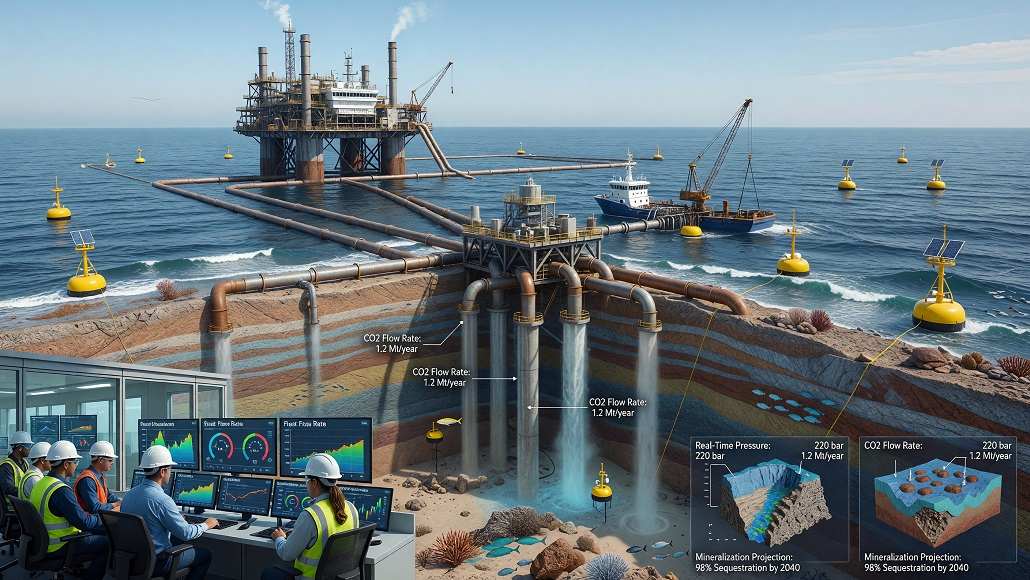
The technical heart of the deployment process is the subsea CO2 injection system. Unlike traditional gas injection used in enhanced oil recovery, carbon sequestration requires systems that can handle high volumes of CO2 over long operational lifespans without failure. Modern injection wells are equipped with sophisticated monitoring tools, including fiber-optic sensors that provide real-time data on temperature, pressure, and flow rates. This level of visibility is essential for ensuring that the injection process does not exceed the structural limits of the reservoir or the cap rock, maintaining the long-term integrity of the storage site.
Materials science also plays a critical role in the development of these systems. Carbon dioxide can form carbonic acid in the presence of moisture, which is highly aggressive toward standard carbon steel. Consequently, offshore carbon capture storage project deployment often involves the use of high-chromium alloys and specialized cements that can resist corrosion for decades. The development of “smart” injection manifolds and autonomous subsea control modules further enhances the reliability of these systems, allowing for precise management of the injection profile across multiple wells. These technological innovations are reducing the risk and cost of CCS, paving the way for the next generation of large-scale offshore decarbonization initiatives.
Economic Drivers and the Commercialization of CCUS Offshore
While the technical feasibility of offshore carbon capture is well-established, the pace of offshore carbon capture storage project deployment is largely dictated by economic factors. The high capital expenditure required for subsea infrastructure and capture facilities means that projects often require significant policy support to be viable. Carbon pricing mechanisms, tax credits (such as the 45Q in the United States), and direct government grants are currently the primary drivers of investment in offshore CCS projects. These incentives create a predictable revenue stream for operators, allowing them to justify the long-term investment required for large-scale sequestration.
Furthermore, the industry is moving toward “hub-and-spoke” models to achieve economies of scale. By creating centralized offshore storage hubs that serve multiple industrial emitters, the cost of transport and injection infrastructure can be shared across a larger volume of CO2. This collaborative approach is essential for reducing the per-ton cost of carbon storage, making it more accessible to a wider range of industries. As the market for carbon management matures, the emergence of “carbon-as-a-service” business models is expected to accelerate the deployment of CCUS offshore, turning the offshore energy industry into a global provider of climate mitigation services.
Regulatory Frameworks and Environmental Stewardship
Ensuring the safety and permanence of carbon sequestration requires a robust and transparent regulatory framework. Governments around the world are developing specific standards for the licensing, operation, and long-term monitoring of carbon storage reservoirs. These regulations often require operators to provide financial guarantees for the eventual decommissioning of the site and to maintain monitoring programs for decades after injection has ceased. This focus on long-term liability is critical for building public trust in offshore carbon capture storage project deployment, ensuring that the environmental benefits are not undermined by unforeseen leaks or structural failures.
Environmental stewardship also involves minimizing the impact of the deployment process itself. This includes conducting rigorous environmental impact assessments to protect marine biodiversity and ensuring that the installation of subsea pipelines and injection manifolds does not disrupt sensitive habitats. The use of low-emission construction vessels and the integration of renewable energy to power the injection facilities are also becoming common features of modern offshore CCS projects. By aligning carbon management with the broader principles of offshore sustainability, the industry is demonstrating that it can be a responsible leader in the global transition to a low-carbon economy.
Technological Innovation and the Future of Offshore Decarbonization
The future of offshore carbon capture storage project deployment will be defined by continuous innovation. One of the most promising areas of research is “carbon mineralization,” where CO2 is injected into basaltic rock formations, where it reacts to form solid carbonate minerals. This process effectively turns the gas into stone, providing an even more permanent and secure storage solution than traditional geological trapping. While currently in the early stages of development for the offshore environment, mineralization could significantly expand the range of suitable carbon storage reservoirs globally, particularly in volcanic regions.
The integration of offshore CCS with hydrogen production is another exciting frontier. “Blue hydrogen” is produced by reforming natural gas, with the resulting CO2 being captured and stored offshore. This allows for the production of a zero-emission fuel source that can utilize existing gas infrastructure and expertise. As the demand for hydrogen grows, the synergy between gas production and CCUS offshore will become a major driver of offshore decarbonization. The ability to produce and store energy in a single integrated offshore complex represents the pinnacle of modern energy engineering, offering a sustainable path forward for the global energy system.
Conclusion: Securing a Sustainable Legacy
In conclusion, the successful offshore carbon capture storage project deployment is a critical component of the global strategy to mitigate climate change. By leveraging the vast capacity of carbon storage reservoirs and the technical precision of subsea CO2 injection, the offshore industry is providing a vital service that allows heavy industry to continue operating while meeting ambitious emissions targets. This journey is marked by significant technical, economic, and regulatory challenges, but the potential rewards in terms of environmental preservation and industrial resilience are immense.
As the industry continues to evolve, the focus must remain on innovation, transparency, and collaboration. The lessons learned from the first generation of offshore CCS projects will provide the roadmap for the global expansion of carbon management, ensuring that the transition to a net-zero future is both secure and sustainable. The offshore environment has long been a source of energy for the world; now, it is set to become its most important guardian, providing the permanent storage needed to protect the planet for generations to come. Through a steadfast commitment to technological excellence and environmental stewardship, the vision of a decarbonized offshore energy sector is becoming an operational reality.
